
AHPA Briefs
August 21, 2026
SNAP Work Requirements Reveal Reduced Participation
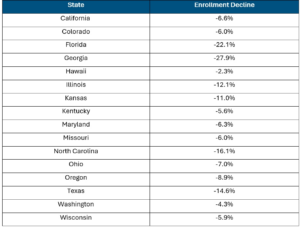
When the One Big Beautiful Bill Act (OBBBA) was enacted, many warned that reductions to the Supplemental Nutrition Assistance Program (SNAP) could jeopardize access to food assistance for those enrolled in the program, particularly children. One year later, those concerns have begun to become measurable. Preliminary U.S. Department of Agriculture (USDA) data show that SNAP participation dropped by more than 4.5 million, including 1.5 million of whom are children, between the law’s July 2025 enactment and April 2026. The impact varied considerably across AHPA states, with participation declining by as much as 27.9% in Georgia and as little as 2.3% in Hawaii.
What do the latest SNAP enrollment data show?
According to the preliminary data provided by the USDA, SNAP enrollment has fallen from nearly 43 million participants in July 2025 to approximately 37 million in April 2026, an 11% decrease. Arizona saw the most significant declines nationally, with a 54.8% reduction in SNAP participation.
What impact are we seeing in AHPA states?
Below is a chart that summarizes impact to AHPA states based on the most recent data by the USDA, which captures enrollment between July 2025 and April 2026. To see national data, click here.
How does this connect to the OBBBA?
The OBBBA included several key provisions designed to shift a greater share of program costs to states and reduce federal spending, including:
- Expanded work requirements: The OBBBA expanded SNAP work requirements by raising the exemption age to 65, increasing compliance obligations for able-bodied adults, limiting the dependent care exemption to households with children under 14, and eliminating important exemptions like those for people experiencing homelessness, veterans, and young adults under 24 years old. While the added work requirements create one barrier to participation, the program’s documentation and recertification requirements present another.
- More administrative burden: To obtain and maintain benefits, individuals must regularly submit eligibility information and supporting documentation to state agencies, increasing the administrative burden on both applicants and agencies.
- Cost shifts to states: Prior to the OBBBA, the federal government covered 50% of SNAP administrative costs. Beginning in fiscal year 2027, the federal share will be reduced to 25%, requiring states to assume responsibility for 75% of the costs associated with administering the program.
What is Congress doing in response?
- Growing concerns about food insecurity and healthcare access have prompted members of Congress to introduce legislation aimed at expanding support for vulnerable populations and strengthening SNAP.
- Senator Josh Hawley (R-MO) introduced the Keep SNAP Funded Act of 2025, which would ensure that SNAP benefits remain uninterrupted if Congress fails to pass the Department of Agriculture’s Budget for FY 2026.
- Representatives Janelle Bynum (D-OR) and Shomari C. Figures (D-AL) introduced the Save SNAP Act and the Rural Health Resilience Act.
- The Save SNAP Act would help ensure continued access to SNAP benefits by maintaining federal funding for states facing new cost-sharing obligations.
- The Rural Health Resilience Act would provide targeted financial assistance to rural health facilities, helping preserve essential healthcare services in communities that often face limited access to care.

