
AHPA Briefs
October 2, 2026
Rural Health Transformation Program Review
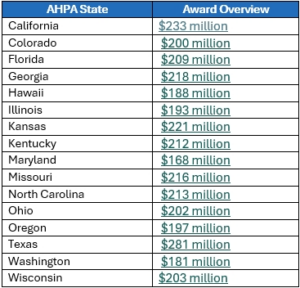
The One Big Beautiful Bill Act (OBBBA) appropriated $50 billion over five fiscal years for the Rural Healthcare Transformation Program (RHTP), a significant investment to strengthen and modernize healthcare delivery in rural communities. From FY 2026 through FY 2030, up to $10 billion will be available annually to participating states. Half of the funding will be distributed equally among participating states, while the remaining half will be allocated by CMS based on state-specific factors, including the number, capacity, and condition of rural healthcare facilities. States are responsible for designing and administering their own funding opportunities. A directory of state-specific funding opportunities is available here; a summary of each state award is available here. The RHTP is now live in all 50 states and states have begun administering applications.
Among AHPA states, Texas received the largest RHTP award, at $281 million, and will use the funds to grow the rural healthcare workforce and prioritize Make America Healthy Again (MAHA) initiatives. Maryland received the smallest award at $168 million and is prioritizing bolstering health care access and affordability in its most rural communities.
Missouri received the ninth-largest award nationwide, totalling $216 million, and is pursuing initiatives to expand rural healthcare access through remote patient monitoring for maternal care and other rural telehealth solutions. The state is also investing in Mobile Integrated Healthcare and Community Paramedicine programs, offering up to $250,000 in startup funding for Emergency Medical Services agencies and up to $500,000 for larger regional systems.
In Florida, Governor Ron DeSantis authorized $188 million of the state’s $209 million award to expand access to rural healthcare services.
North Carolina received $213 million and is prioritizing connectivity through NC HealthConnex, the state’s health information exchange, while supporting the adoption of AI-driven clinical decision support tools, expanding capacity for emerging technologies, and increasing engagement among rural residents.
Kansas is focused on improving access to social services, clinical nutrition programs, and investing in emerging technologies.
Kentucky is prioritizing enhancements to pre-hospital care capacity, trauma system coordination, dental access, and maternal health.
Ohio is focusing on rural health workforce development, innovative care, and tech innovation to improve service delivery.
Oregon is launching initiatives to help improve the health and care access to tribes living in rural communities throughout the state.
Washington is investing in expanding and sustaining the state’s rural behavioural health system and investing in long-term solutions to give better access to specialty and emergency medical care.
Wisconsin is investing in improving rural dental care, care coordination, and rural technology transformation.



Promoting wholeness
to live God’s healing love
Subscribe to AHPA resources

818 Connecticut Ave, NW,
Suite 1100
Washington, DC 20006
Copyright 2026
